Stepping Into the Soul of Ancient Greece
You know that feeling when history isn’t just written in books but pulses beneath your feet? That’s Olympia. Walking through the sacred grounds where the first Olympic flame ever burned, I swear I could hear echoes of ancient cheers. This isn’t just ruins and statues—it’s raw, living culture. The air smells like olive trees and time. If you’ve ever wondered what it truly means to connect with the past, this is where it happens. More than a destination, Olympia offers a rare invitation: to slow down, to listen, and to stand in the presence of something greater than oneself. For travelers seeking meaning beyond the surface, this quiet valley in the Peloponnese becomes not just a stop on a map, but a moment of transformation.
The First Step: Arriving in a Timeless Valley
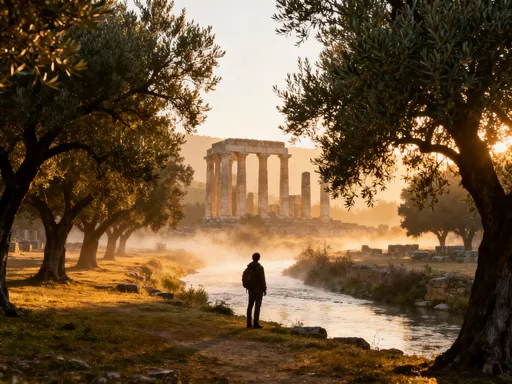
Reaching Olympia feels less like arriving at a tourist site and more like stepping into a sanctuary preserved by time. Nestled in the western Peloponnese, the journey here—whether by car from Athens or by regional train—gradually shifts from bustling cityscapes to rolling hills blanketed in silver-green olive groves and fragrant wild herbs. As visitors approach, the modern world softens. The Alpheios River glides silently through the valley, its waters reflecting the same sky that once watched over ancient athletes and priests. The air cools, carrying the scent of thyme, pine, and damp earth—a natural perfume that signals entry into a place set apart.
Upon arrival, the first impression is one of serenity. Unlike crowded coastal resorts or noisy urban centers, Olympia exudes a quiet reverence. The archaeological site lies just beyond the modern village, where small family-run shops sell handmade soaps infused with local olive oil and pottery inspired by ancient designs. The rhythm of life here is unhurried. Locals greet each other by name, and time seems to stretch, allowing space for conversation, contemplation, and connection. This deliberate pace prepares the visitor for what lies ahead—not just a collection of ruins, but a living landscape shaped by centuries of devotion, competition, and communal memory.
The transition from modern Greece to ancient stillness is seamless. There are no jarring signs or oversized tourist complexes. Instead, the site unfolds naturally, framed by cypress trees and low stone walls. The journey to Olympia is not merely geographical—it is psychological. One leaves behind the noise of daily life and enters a space where history is not observed from a distance but experienced through the senses. The crunch of gravel underfoot, the warmth of sun-baked stone, the distant call of a shepherd’s bell—all contribute to a deeper awareness of place. This is not a performance of the past; it is an immersion in its enduring presence.
Sanctuary of Zeus: More Than Just Stone
The heart of ancient Olympia was not the stadium, but the Sanctuary of Zeus—the sacred Altis grove where gods and mortals met. This was no ordinary temple complex; it was a Panhellenic center, drawing pilgrims from across the Greek world every four years for the Olympic Games. The sanctuary’s significance extended far beyond athletic competition. It was a place of worship, prophecy, and political unity, where city-states laid down arms in observance of the sacred truce, or *ekecheiria*. To walk through its remains today is to encounter the spiritual foundation of one of history’s most enduring traditions.
At the center stood the Temple of Zeus, once housing one of the Seven Wonders of the Ancient World: a towering statue of the god crafted by the sculptor Phidias in gold and ivory. Though the statue is long gone, its foundation remains, allowing visitors to trace its immense scale. The temple’s columns, though partially reconstructed, still convey a sense of awe. Standing within the Altis, surrounded by the remains of altars, treasuries, and votive offerings, one senses the weight of ritual. This was where athletes swore oaths, where sacrifices were made to honor the gods, and where oracles interpreted divine will. Religion and sport were inseparable—victory was not merely a personal achievement but a sign of divine favor.
The Bouleuterion, the council house where Olympic officials gathered, speaks to the sophisticated organization behind the Games. Here, judges from Elis oversaw athlete qualifications, resolved disputes, and ensured adherence to sacred rules. The site also includes the Metroon, originally a temple to the mother goddess Rhea, later repurposed as an archive. These structures reveal that Olympia was not just a ceremonial ground but a functioning administrative and religious hub. Every stone tells a story of governance, faith, and collective identity. To understand Olympia is to recognize that the Games were never just about physical prowess—they were about honor, piety, and the pursuit of excellence in service to something greater.
Where Athletes Once Stood: The Ancient Stadium and Training Grounds
A short path from the sanctuary leads to the ancient stadium, where the Olympic Games were held for over a millennium. Unlike modern arenas with towering stands and electronic scoreboards, this stadium is simple, carved into the natural slope of the hill. Its earthen track, 212 meters long, remains largely intact. As visitors walk the same ground where runners once sprinted naked in the scorching summer sun, the past feels startlingly close. The starting blocks, with their carved footprints and stone barriers, still mark the line from which destinies were launched. It is here, more than anywhere else, that one can imagine the roar of the crowd—tens of thousands of spectators from across Greece, their voices rising in unison.
The Games began in 776 BCE and continued for nearly 12 centuries, a testament to their cultural importance. Events included the *stadion* race, wrestling, boxing, chariot racing, and the grueling *pankration*, a mix of martial arts and wrestling with few rules. Victory brought more than fame—it conferred divine status. Winners were celebrated as heroes in their hometowns, their names inscribed on stone, their likenesses sculpted in bronze. The pursuit of *arete*, or excellence, was not just athletic but moral—a reflection of discipline, courage, and self-mastery. The stadium was not merely a venue; it was a stage for human aspiration.
Nearby, the *palaestra* offers insight into the athletes’ daily lives. This square courtyard, surrounded by colonnades, was where wrestlers, boxers, and other competitors trained. Rooms for bathing, oiling, and resting lined its perimeter. Athletes arrived weeks in advance to prepare under the watchful eyes of trainers and judges. They followed strict diets, adhered to rigorous schedules, and lived in communal quarters. The emphasis was not on entertainment but on purity of effort. Modern visitors can trace the outlines of training areas, imagining the grunts of exertion, the scent of olive oil, and the dust rising from practiced moves. These grounds remind us that the Olympic ideal was never about winning at all costs—it was about striving with integrity, respect, and reverence for the sacred contest.
The Modern Pilgrim: Experiencing Culture, Not Just Sightseeing
To visit Olympia as a tourist is to observe. To visit as a modern pilgrim is to participate. While the archaeological site offers profound historical insight, the true soul of Olympia lives in its living culture. Local festivals, seasonal rituals, and everyday traditions keep the spirit of the past alive in ways that museums cannot replicate. One such moment comes each summer during the lighting of the Olympic flame—a ceremony held at the Temple of Hera, where women in ancient-style robes use a parabolic mirror to ignite the torch. Though televised globally, witnessing it in person is transcendent. The hush of the crowd, the precision of the ritual, the flame catching in the morning light—these are not reenactments, but renewals of a timeless tradition.
Equally powerful is the warmth of Greek hospitality. In the village of Olympia, family-run tavernas serve dishes rooted in centuries-old practices. A simple meal of *stifado*—a rich beef stew with onions and cinnamon—paired with local red wine from the nearby region of Ilia, becomes an act of cultural communion. The food is slow, seasonal, and shared with pride. Conversations with owners often turn to stories of ancestors who worked the land or preserved local customs. These interactions remind visitors that heritage is not frozen in stone—it is cultivated daily, passed down through generations, and expressed in the rhythms of ordinary life.
Seasonal events further deepen the connection. In spring, wildflowers blanket the hillsides; in autumn, the olive harvest brings families together to gather fruit by hand. These cycles mirror the ancient reverence for nature and the divine order of time. Travelers who stay beyond a day begin to sense the continuity between past and present. They learn that to honor Olympia is not just to admire its ruins, but to engage with its people, its food, and its quiet wisdom. This kind of travel—intentional, respectful, and open-hearted—transforms sightseeing into a journey of meaning.
Museum Secrets: Faces and Fragments of Antiquity
The on-site Museum of the History of the Ancient Olympic Games is not an afterthought—it is a vital companion to the ruins. Housed in a modern yet understated building, it protects and presents artifacts that bring the ancient world to life. Among its treasures is the *Hermes of Praxiteles*, a marble statue discovered in the Temple of Hera. Believed to depict the god holding the infant Dionysus, the sculpture radiates grace and humanity. Its delicate features, lifelike posture, and subtle expression make the divine feel approachable. Standing before it, one does not see a distant idol but a being of warmth and presence—proof that ancient artists sought not just to represent, but to evoke emotion.
Other exhibits offer equally intimate glimpses into the past. Bronze armor worn by competitors, inscribed victory ribbons, and stone slabs listing the names of champions connect abstract history to real individuals. One fragment records the victory of a runner from Rhodes, his name etched with pride. Another displays a child’s toy—perhaps once played with by the son of a visiting athlete. These objects dissolve the distance between then and now. They remind us that the people of ancient Olympia laughed, trained, hoped, and celebrated just as we do. The museum does not glorify the past; it humanizes it.
Interactive displays and clear, multilingual descriptions enhance understanding without overwhelming. Maps show the spread of Olympic influence across the Mediterranean. Timelines outline the evolution of events and rules. But the most powerful moments are the quiet ones—standing before a worn sandal sole, imagining the feet that once filled it, or reading a judge’s inscription demanding fair play. The museum does not merely display artifacts; it invites reflection. It asks visitors to consider what these objects meant to those who used them, and what they might still mean to us. In doing so, it transforms history from a subject to be studied into a conversation to be joined.
Beyond the Main Site: Hidden Corners and Local Life
While the sanctuary and stadium draw the majority of visitors, Olympia’s deeper magic lies in its quieter corners. A short walk from the main site leads to the Kladeos River, where willow trees lean over slow-moving water. Footpaths follow its banks, offering shade and solitude. These trails, rarely crowded, allow for contemplative walks where the only sounds are birdsong and rustling leaves. Along the way, remnants of ancient bridges and stone fords hint at the infrastructure that once supported thousands of pilgrims. Nature and history coexist here, not in conflict but in harmony.
Another hidden gem is the Byzantine church of Agios Andreas, perched on a hill overlooking the valley. Built centuries after the decline of the Olympic Games, it stands as a testament to the continuity of sacred space. Though small, its frescoes and stone arches convey a sense of enduring devotion. Locals still visit for feast days, lighting candles and offering prayers. This layering of time—ancient, medieval, modern—reveals how spiritual significance can persist across eras, adapting without losing its essence.
In the surrounding countryside, olive groves stretch across the hills, many still cultivated by hand. Families harvest the fruit each autumn, pressing it into golden oil that carries the flavor of the land. Some open their homes for agritourism, offering guests the chance to pick olives, press oil, and share meals. These experiences foster a deep appreciation for the region’s agricultural heritage. They also reveal a truth often missed by tourists: that history is not only in monuments, but in the hands that work the soil, the recipes passed from grandmother to granddaughter, and the stories told over evening coffee. To know Olympia fully is to venture beyond the guidebook and into the lives of those who call it home.
Why This Place Changes How You See History
Standing at the starting line of the ancient stadium, with the sun warming the same stones that witnessed the first Olympic race, something shifts. History ceases to be a subject confined to classrooms and textbooks. It becomes immediate, personal, and deeply felt. Olympia does not merely display the past—it allows us to inhabit it, if only for a moment. This is the power of place: to collapse time, to make the distant feel near, and to remind us that we are part of a long human story.
The values celebrated in ancient Olympia—discipline, fairness, respect, and the pursuit of excellence—resonate just as strongly today. In a world often driven by speed, distraction, and division, the Olympic ideal offers a counterpoint: a call to strive not for dominance, but for self-improvement; not for spectacle, but for meaning. These are not relics of a bygone era but living principles, waiting to be reclaimed.
Traveling to Olympia with intention transforms the journey from a checklist of sights to a pilgrimage of understanding. It invites us to slow down, to listen, and to reflect on what truly endures. The stones will remain, the rivers will flow, and the olive trees will grow. But it is up to each visitor to carry the spirit forward—not as nostalgia, but as inspiration. In a single step across ancient ground, one can rediscover the soul of Greece, and perhaps, a deeper part of oneself.